The skin is not a surface. It is an ecosystem.
Your skin is home to billions of bacteria, fungi and other microorganisms. Most of them are not your enemy. Together they form a living ecosystem that protects you, regulating inflammation, strengthening the skin barrier and keeping harmful microbes from taking over.
When that ecosystem is in balance, the skin defends itself. When it is not, opportunistic fungi find the space to grow. This happens not just on the feet, but wherever the skin is warm, moist or under stress: skin folds, the groin, the torso, the scalp. Fungal overgrowth is a skin ecosystem problem, not a location-specific one.
This does not mean antimycotics are wrong. They remain essential when a patient needs acute relief. But eliminating the pathogen is only half the job. If the ecosystem that allowed it to dominate is never restored, the conditions for recurrence remain. Effective fungal skin care increasingly means two things at once: controlling the overgrowth and rebuilding the balance that prevents it from returning.
The antimycotic paradox
Antimycotics are effective. That is not the question.
The question is what happens after. Azoles, allylamines and polyenes eliminate fungal overgrowth, but they do so without distinguishing between pathogenic fungi and the commensal bacterial communities that naturally keep fungal populations in check. The result is a microbiome that is quieter, but not healthier.
Add to this the growing evidence of antifungal resistance. Candida auris, Trichophyton indotineae and resistant strains of Aspergillus fumigatus are already classified as urgent threats by the WHO and CDC. Resistance to terbinafine, one of the most widely used antifungal treatments, is rising in clinical isolates across Europe and Asia.
This does not make antimycotics obsolete. It makes the case for using them more precisely and less repeatedly. Microbiome-first approaches reduce the need for repeated antifungal cycles, which is both better for the patient and better for antimicrobial stewardship.
Why recurrence demands a new model
Recurrence is not a side effect of treatment. In many cases, it is a consequence of it. Broad-spectrum antifungal treatments eliminate the target pathogen. They also disrupt the commensal bacterial communities that naturally suppress fungal overgrowth. Once treatment stops, the ecosystem remains depleted and the conditions that enabled the original infection return.
Microbiome-first approaches address this differently. Rather than focusing solely on pathogen elimination, they aim to restore the microbial balance that makes the skin naturally resilient. The goal is not sterilisation. It is sustained ecological recovery.
What microbiome-safe antifungal care looks like in practice
At YUN Probiotherapy, we built our platform around this principle.
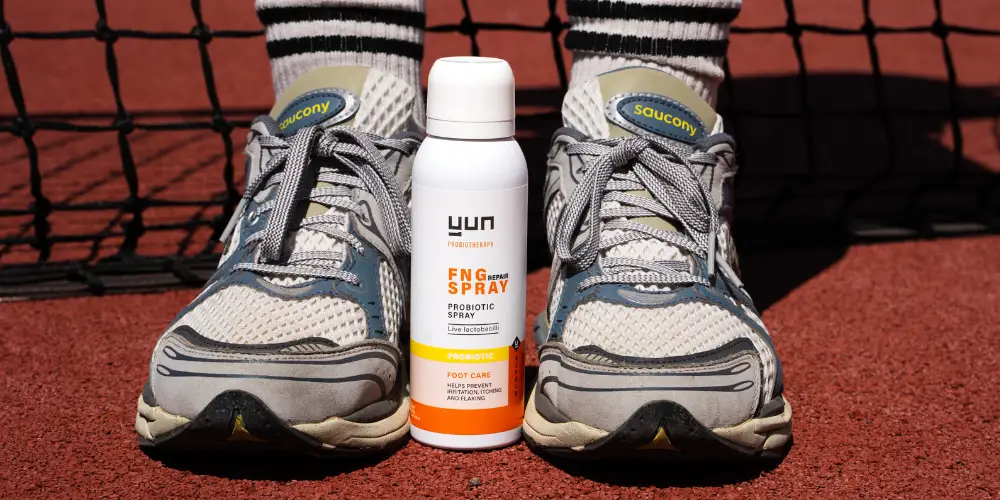
Our FNG range is designed for fungus-prone skin: feet, skin folds, fissures and other areas where moisture and friction create the conditions for fungal overgrowth. It combines a patented probiotic spray containing live lactobacilli with a prebiotic wash gel that nourishes the good bacteria already on the skin.
The live strains we use L. plantarum YUN-V2.0 and L. rhamnosus YUN-S1.0, were selected for their ability to actively compete with and suppress fungal pathogens. In a peer-reviewed clinical study published in Cell Reports Medicine, topically applied lactobacilli demonstrated selective targeting of skin pathobionts and a measurable anti-inflammatory effect. In clinical evaluation of the FNG range specifically, 94 percent of patients showed improvement in symptoms including itching, irritation and flaking.
The formulation contains no harsh preservatives or surfactants that would undermine the microbiome it is designed to restore. This is not a cosmetic claim. It is the biological logic behind the product: a healthy skin ecosystem defends itself.
What this means for dermatology and pharmaceutical partners
The convergence of microbiome science with antifungal care reflects a broader shift in how skin health is understood. One that is already influencing clinical practice and commercial strategy.
Patients increasingly understand that not all microorganisms are harmful and that preserving beneficial bacteria matters for long-term skin health. Healthcare professionals are looking for approaches that reduce reliance on repeated antifungal cycles. And the rise of antimicrobial resistance is adding scientific urgency to the search for alternatives.
For pharmaceutical distributors and dermatology partners, this creates a concrete opportunity: a clinically differentiated category that addresses recurrence, not just acute symptoms, and builds patient retention through outcomes that last.
The future of fungal skin care
The future of antifungal innovation will not be defined by suppression alone. The next generation of solutions will address both dimensions simultaneously: controlling harmful overgrowth while restoring the microbial resilience that prevents it from returning. That is not a trend. It is the logical conclusion of what microbiome science has been telling us for a decade.
At YUN Probiotherapy, it is also what we have been building.
Interested in what a microbiome-first approach could mean for your dermatology or antifungal portfolio?
We welcome the conversation. info@yun-probiotherapy.com
 Discover our full human portfolio: click here
Want to read more on our scientific evidence & publications? Click here
Sources
- Lebeer S. et al. Selective targeting of skin pathobionts and inflammation with topically applied lactobacilli. Cell Reports Medicine (2022). https://www.cell.com/cell-reports-medicine/fulltext/S2666-3791(22)00021-0
- Olunoiki E. et al. Characteristics of the Skin Microbiome in Selected Dermatological Conditions. Life(2022).
- Byrd A.L. et al. Forgotten Fungi: The Importance of the Skin Mycobiome. Current Opinion in Microbiology (2022).
- Oh J. et al. The Human Skin Microbiome: From Metagenomes to Therapeutics. Nature Reviews Microbiology (2025).
- Gunaydin S.D. et al. Fungal Infections of the Skin and Soft Tissue. Current Opinion in Infectious Diseases (2020).
- Gupta A.K. et al. Antifungal resistance in dermatophytes. Journal of the American Academy of Dermatology (2023).
- WHO Fungal Priority Pathogens List (2022).