What if supporting the ear microbiome could change how we approach ear care in dogs?
19/05/2026 | Probiotherapy | 5 min read

“Antimicrobial resistance remains a growing global challenge, including in veterinary medicine."
Ear infections are one of the most common reasons dog owners visit the vet. And they often keep coming back. This has led to growing interest in solutions that go beyond short-term approaches and instead support the ear’s natural balance.
A healthy ear is full of beneficial bacteria
What many people do not realise is that a healthy dog’s ear is far from sterile. It hosts a rich microbial community, with Lactobacilli among its key residents.
When this balance is disrupted, the microbiome can shift, allowing less desirable microorganisms to dominate. Beneficial bacteria disappear, while harmful pathogens take over. Which raises a logical question: what if restoring beneficial bacteria could help rebalance the ear environment?
Our new study helps to provide an answer
Our latest publication in Veterinary Dermatology is now live. This work was developed through a close collaboration between YUN and Ecuphar NV, a company of Animalcare Group.
The paper reports both the in vitro antipathogenic activity and the engraftment of proAuris, ear drops containing live lactobacillus strains. A meaningful step towards microbiome-driven approaches in veterinary medicine.
Do the probiotic bacteria actually persist?
After a single application of proAuris, containing two specific YUN bacterial strains, the bacteria were still detected in the ear canals of 15 healthy dogs one week later. The strains adhere to the skin lining and remain actively present.
Interaction with other microorganisms
In laboratory conditions, the strains demonstrated inhibitory activity against microorganisms commonly associated with ear imbalances, including Pseudomonas aeruginosa, Staphylococcus pseudointermedius and Malassezia pachydermatis.
These findings provide insight into how beneficial bacteria may interact within the microbial ecosystem of the ear. Proposed mechanisms include: competition for space and nutrients, production of naturally occurring inhibitory compounds and contribution to a less favourable environment for certain microorganisms.
What does this mean in practice?
While these results are based on in vitro and early-stage observations, they support the growing interest in microbiome-based approaches as a complementary way to support ear health. Further studies in clinical settings will help to better understand the practical relevance of these findings. But the scientific evidence continues to grow.
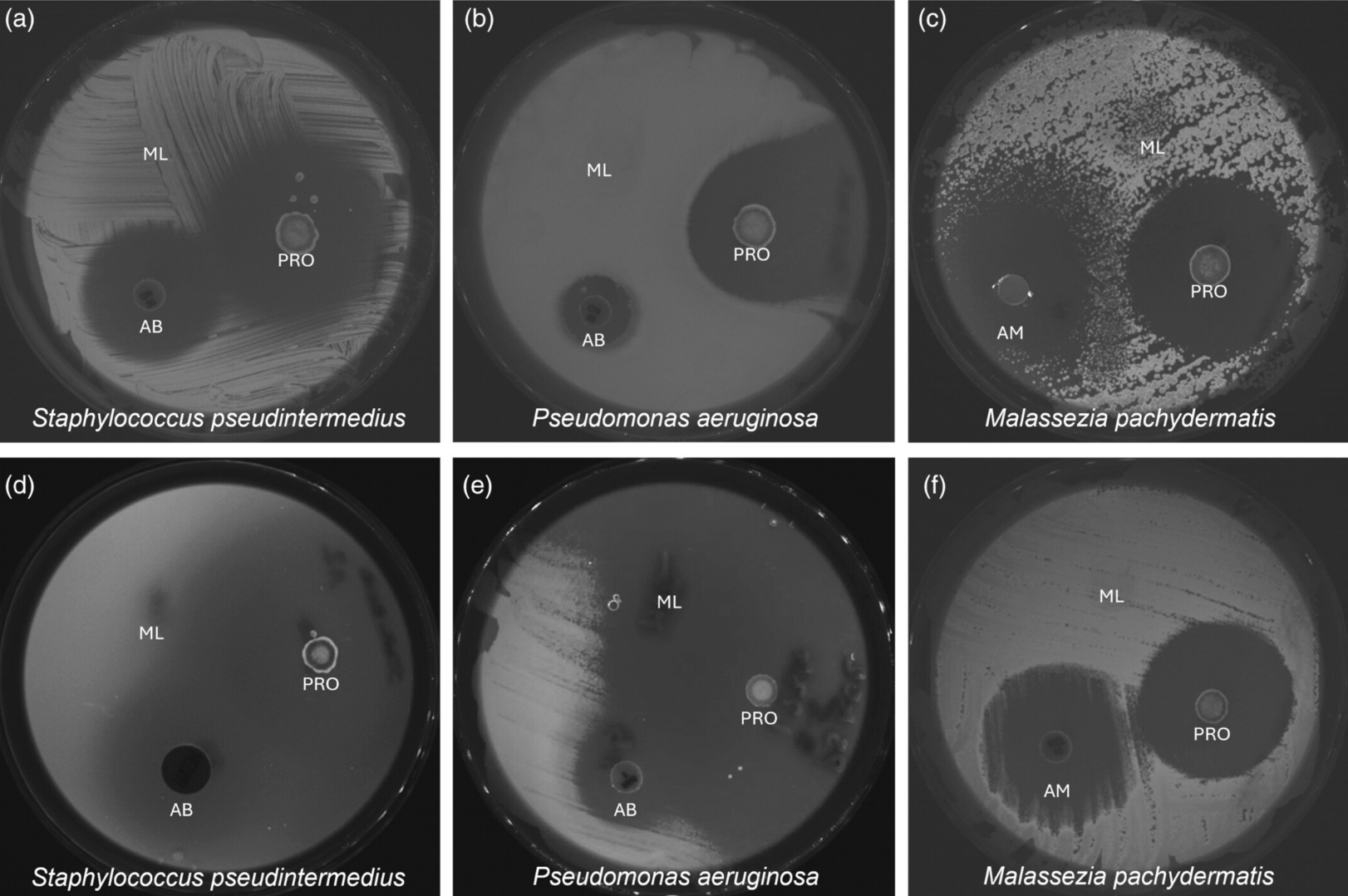
In vitro inhibition of canine ear pathogens by probiotic ear drops (PRO), antibiotics/antimycotic (AB/AM) and a negative control (Micrococcus luteus—ML). Each panel (a–f) shows inhibition zones for a single pathogen: Staphylococcus pseudintermedius (a, d), Pseudomonas aeruginosa (b, e), and Malassezia pachydermatis (c, f). Antimicrobials used were gentamicin (a, b), neomycin (d), marbofloxacin (e), terbinafine (c), and miconazole (f).
Looking ahead
Antimicrobial resistance remains a growing global challenge, including in veterinary medicine. This has increased interest in approaches that promote responsible use and support overall health management strategies.
In this context, as the focus on responsible and sustainable approaches continues to grow, solutions that work in harmony with the microbiome are gaining increasing attention. Research like this represents an important step towards better understanding their role in supporting dog ear health.
Reference: Salichs et al. (2025). Veterinary Dermatology. https://doi.org/10.1111/vde.70080
Read the full publication here: Probiotic Engraftment and Suppression of Canine Otitis Externa Pathogens by Probiotic Ear Drops
Exploring microbiome-safe or bacteria-based approaches for your animal care portfolio? We welcome the conversation.

The future of health
is microbiome-safe
The industry is changing. Consumers demand safer, natural solutions and microbiome-safe care is becoming the new standard.
At YUN, we lead this shift and help businesses to stay ahead of it. By integrating our Microbiome-Safe Scoring into product development, we provide the scientific foundation to create trusted, microbiome-friendly innovations that meet this rising demand. Our innovations are already proving that protecting the microbiome is not just better for health, but essential.
Microbiome-safe is no longer a trend. It is the foundation for the next generation of care.