Antimicrobial resistance is accelerating. Dermatology needs a new model.
19/05/2026 | Probiotherapy | 5 min read
“The future of skin health is not more destruction. It is precision with preservation."
By 2050, antimicrobial resistance (AMR) is projected to kill more people than cancer. Nearly 40 million direct deaths worldwide, with annual deaths rising sharply if current antibiotic practices continue unchecked. Dermatology is part of that story.
For decades, inflammatory skin conditions have been managed through repeated antimicrobial suppression. While effective in the short term, this approach also contributes to the growing resistance challenge healthcare systems are now trying to solve.
A deeper question
Molecular diagnostics have given clinicians remarkable precision. Specific pathogens can now be identified faster and more accurately than ever, enabling more targeted treatments and reducing unnecessary antibiotic use. This is progress.
But precision diagnostics answer one question: which organism is causing the problem?
Microbiome science invites a different one: why does that organism gain the upper hand in the first place?
Research increasingly shows that skin dysbiosis, an imbalance in the microbial community, creates the conditions in which harmful bacteria thrive. The problem is not just the pathogen. It is the environment that allowed it to dominate.
Treating the pathogen without restoring that environment is like clearing weeds without improving the soil. They come back. And every time they come back requiring a stronger antibiotic, we move one step closer to the 2050 projection nobody wants to reach.
What microbiome-first care looks like in practice
At YUN Probiotherapy, we approach skin health from the ecosystem up.
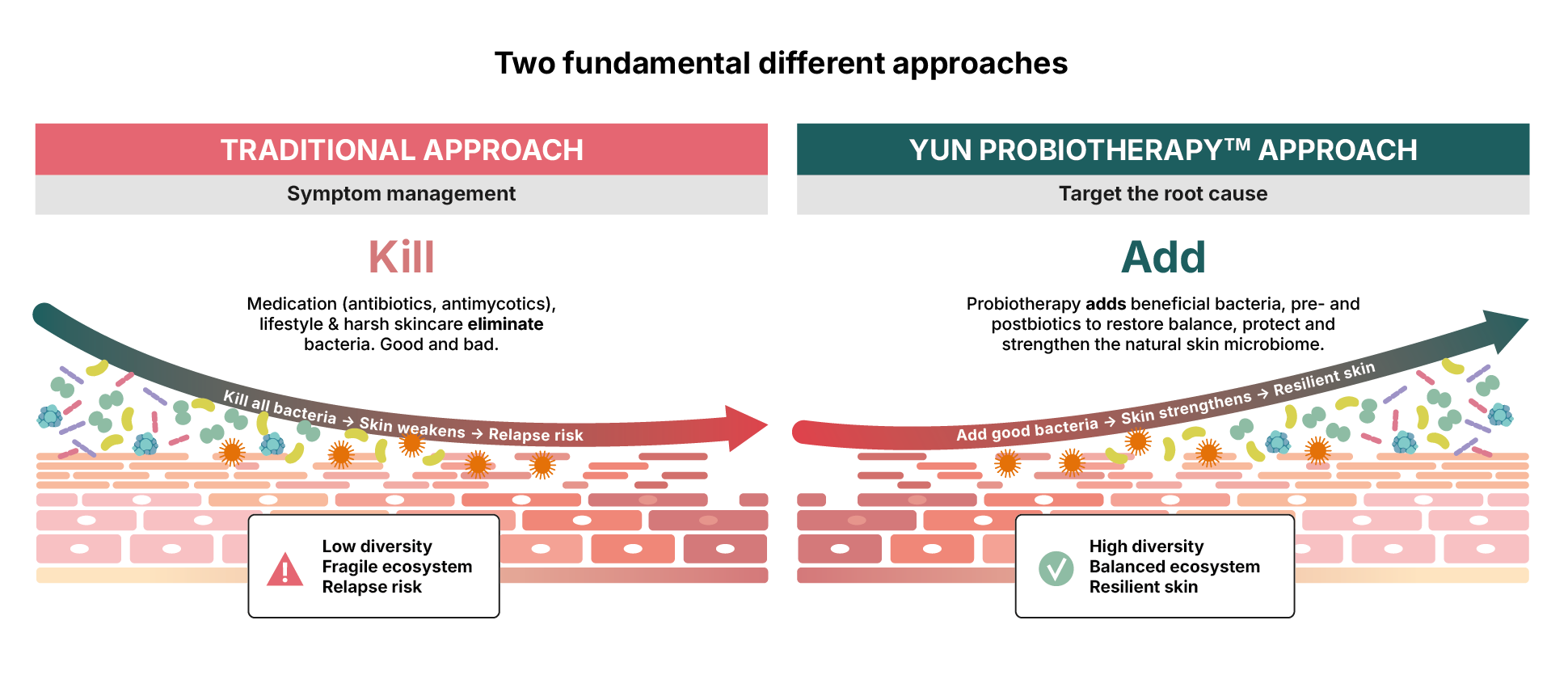
Rather than asking how to eliminate microbes more efficiently, we ask how to support the biological systems that naturally keep microbes in balance. In practice, this means working with beneficial bacteria that actively compete with and suppress harmful ones, without antibiotics. Formulating products that preserve the existing microbiome rather than stripping it. Strengthening the skin barrier so it becomes less hospitable to the pathogens we want to reduce.
This does not replace acute treatments when they are genuinely needed. When a patient has a serious infection, targeted care is essential. But between flare-ups, and as a long-term strategy, microbiome-first care can reduce how often those acute interventions become necessary. Fewer interventions means less selection pressure for resistance. That is what meaningful antibiotic stewardship looks like in dermatology.
Our approach focuses on 'adding' instead of 'killing'. The model below explains how.
Precision without destruction
The promise of molecular diagnostics is precision. The promise of microbiome science is precision with preservation.
Together, they point toward a fundamentally different model of skin care. One where interventions are targeted, ecosystems are respected, and long-term resilience matters as much as short-term results.
At YUN, this is not a positioning statement. It is the reason our formulations contain no harsh antimicrobials, our probiotic strains are clinically characterised, and our platform is built around one principle: working with biology, not against it.
The bottom line
Ten million deaths a year by 2050. That is the cost of continuing as we are.
The answer will not come from more aggressive suppression. It will come from smarter strategies that reduce the need for antibiotics in the first place. In dermatology, that means taking the skin microbiome seriously, not as a trend, but as a clinical and public health imperative.
The future of skin health is not more destruction. It is precision with preservation.
Exploring microbiome-safe or bacteria-based approaches for your dermatology or consumer health portfolio? We welcome the conversation.

Sources
O'Neill, J. (2014). Antimicrobial Resistance: Tackling a crisis for the health and wealth of nations. Review on Antimicrobial Resistance, commissioned by the UK Government. Cited by WHO and UN.
Murray, C.J.L. et al. (2022). Global burden of bacterial antimicrobial resistance in 2019: a systematic analysis. The Lancet, 399(10325), 629–655.
World Health Organization (2023). Antimicrobial resistance. WHO Global Priority Pathogens List and AMR Action Plan. who.int/news-room/fact-sheets/detail/antimicrobial-resistance
Frontiers Science House, Davos (January 2026). Antimicrobial resistance pandemic will kill more people than cancer by 2050. frontiersin.org
The future of health
is microbiome-safe
The industry is changing. Consumers demand safer, natural solutions and microbiome-safe care is becoming the new standard.
At YUN, we lead this shift and help businesses to stay ahead of it. By integrating our Microbiome-Safe Scoring into product development, we provide the scientific foundation to create trusted, microbiome-friendly innovations that meet this rising demand. Our innovations are already proving that protecting the microbiome is not just better for health, but essential.
Microbiome-safe is no longer a trend. It is the foundation for the next generation of care.